The City of St. Clairsville Police Department is urging all citizens to stay vigilant as a new type of scam is expected to make its way into Ohio. “Brushing” package scams involve the delivery of unordered items to your home, disguised as packages from Amazon or other companies.
If any citizen sees a package that they did not order and it has a QR code (see image), DO NOT SCAN THIS WITH YOUR PHONE!!! The item delivered can be kept or thrown away, but DO NOT SCAN ANY CODE!!!! Once you scan the package’s QR code, it exposes your phone’s personal information—including banking and financial details—which then gives scammers access to all the contents in your device.
How to avoid brushing scams
The FBI provided tips on how to protect yourself against the brushing package scams:
Do not scan a randomly found QR code
Be suspicious if, after scanning a QR code, the site asks for a password or login info
Do not scan QR codes received in emails or text messages unless you know they are legitimate. Call the sender to confirm
Some scammers are physically pasting bogus codes over legitimate ones. If it looks as though a code has been tampered with, don’t use it
PLEASE FOLLOW THE LINK BELOW FOR MORE INFORMATION OR CALL OUR LOCAL POLICE DEPARTMENT 740-365-0123
Mayor Kathryn Thalman submits the following application to the City Council of St. Clairsville. The purpose of this application is to seek council’s approval to establish a Designated Outdoor Refreshment Area in downtown St. Clairsville in accordance with the Ohio Revised Code, Section 4301.82.
Please click the link provided to download and read the application. For questions or concerns please contact the Mayor’s Assistant Jennifer McMillan at 740-695-1324 or email jmcmillan@stclairsville.com
Section 505.16 of the St. Clairsville Codified Ordinances states “No person shall intentionally provide food for deer, geese, ducks, raccoons, rodents, fowl or other wild animals or wild life by setting such food out on any public or private property thereby creating a nuisance that endangers the health, safety, and welfare of the public”. Whoever violates any of the provisions of this Section is guilty of a minor misdemeanor.
It is also important to note that while some may think it is harmless to feed the wildlife in our area, there may be more damage done to the animals then known. This excerpt is from the National Park Service website, although it is regarding feeding wildlife in National Parks, it still applies to our City:
Are You An Animal Lover?
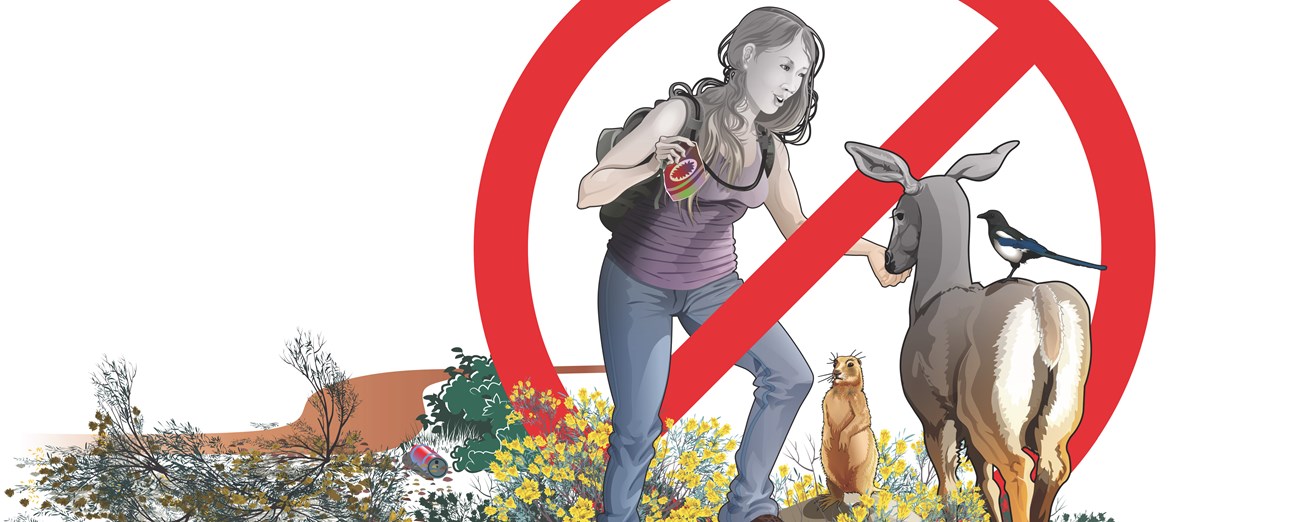
Artwork Brian Roanhorse/NPS
One of the experiences people treasure when visiting national parks and other public lands is the opportunity to view wild animals in their natural habitats. And so it is often with the best intentions, be it gratitude, curiosity, or just plain friendship, that park visitors wish to offer wildlife something in return, rationalizing that “feeding wild animals really doesn’t do any harm.”
Feeding wildlife is actually a form of animal cruelty. Animals that are fed by humans learn to frequent roadsides and parking lots, dramatically increasing their chances of being run over by a careless motorist. Most animals have very specific natural diets and therefore specific kinds of digestive bacteria. Being fed human food causes the wrong type of bacteria to become dominant in their stomachs. Soon these animals are no longer able to digest their natural foods. They end up starving to death with stomachs full of what they should have been eating all along. What could be crueler?
Fed animals also pose a threat to humans. Feeding rodents is especially dangerous because they can transmit diseases deadly to humans, such as Bubonic Plague and Hantavirus. Simply putting yourself within flea-jumping distance (up to 10 feet or 3 meters) of a rodent puts you at risk of contracting one of these diseases. Furthermore, the majority of national park visitors who suffer rodent bites report that they weren’t even offering the animal any food–they were simply extending an empty outstretched hand to lure the animal closer. But because the rodent is so accustomed to a piece of food being at the end of an outstretched hand, they often bite the hand thinking it’s food.
Leaving scraps behind when picnicking, not securing food in approved containers, and careless littering can be just as harmful as feeding an animal by hand. Normally docile animals that become accustomed to frequenting busy areas lose their natural wariness for people and can become dangerously aggressive. A young mule deer buck gored and killed a small child in a Yosemite campground when the boy refused to relinquish his sandwich to the deer. Even though he was doing the right thing, that child died a senseless death because too many people mistakenly thought, “feeding wild animals doesn’t really do any harm”. And in many alreaday tragic cases, normally docile animals are euthanized for the safety of future visitors.
Please be a true friend of wildlife and keep your food and fingers to yourself.
Feeding wildlife is actually a form of animal cruelty.Artwork Brian Roanhorse/NPS
Below (PDF) is a Drinking Water Notice provided by the City of St. Clairsville showing the levels of total Haloacetic Acids were above drinking standard levels put forth by the Environmental Protection Agency (EPA). As stated in the document the levels above standard do not pose an immediate risk. The EPA requires the City to notify each customer of the results of any violation. This has been mailed out to every customer.
The City of St. Clairsville continuously monitors the drinking water provided to its customers and will take extra steps to ensure the drinking water is at peak level for consumption. It is a high priority for the City to provide excellent-quality water to our customers and we take the violations seriously and move to fix any issues immediately. If there are any further questions or concerns, please do not hesitate to contact the Municipal Building at 740-695-0156 or the Water Department at 740-695-1161
Like many communities, the City of St. Clairsville enacted rules that banned the use of lead and required all new residential, private, and public services to be copper. To date, St. Clairsville has evaluated the public side of the water services (the side the City maintains) and replaced all known lead and galvanized water lines.
CUSTOMER-OWNED SERVICE LINES
The survey provided to each customer in St. Clairsville returned findings of:
2 Lead Service Lines
33 Galvanized Required Replacement Service Lines
8 Unknown Status Service Lines
Every home that submitted one of the surveys has received a letter regarding retesting the line or the procedures for replacement. If you require a copy of that letter, please email emoscato@stclairsville.com or call 740-695-0156.
In the link provided below, you will find the complete list of addresses within the City that have turned in a survey response and the description of the home’s pipe material.
Water line tie – in work was finished in your area on Tuesday, November 7th, 2023 at 3:30 p.m.. This work is part of the City’s Water Line Replacement Project.
Resident’s may experience water loss, discoloration, and pressure issues. If you experience water loss, please note that once water is restored, a 48 Hour Boil Order will be in effect. As of 3:20 p.m. today, 11/7/23, the water line tie-line work has finished.
Addresses that are affected:
N. Sugar Street – 103 through and including 113.
Newell Ave. Extension – 203 and 203 ½.
If you have any questions, please contact the Utility Office at 740-695-1410. Thank you.
Replacement of sidewalks will begin in your area on or around Monday, November 6th, 2023. Then later, replacement of removed sections of driveways will take place. This work is part of the City’s Water Line Replacement Project.
Addresses that are affected:
E. Main Street – 167 through and including 277. Odd numbers only.
Forest Lawn-101,102, and 104.
As this project progresses, residents may experience periodic:
Traffic in the neighborhood, and no “on-street” parking allow the contractor to perform the needed work.
If you have any questions, please contact the Utility Office at 740-695-1410.
A copy of the Ohio Auditor’s Office Audit of St. Clairsville, Ohio for the year ending on December 31st, 2022, is available by clicking the link below.